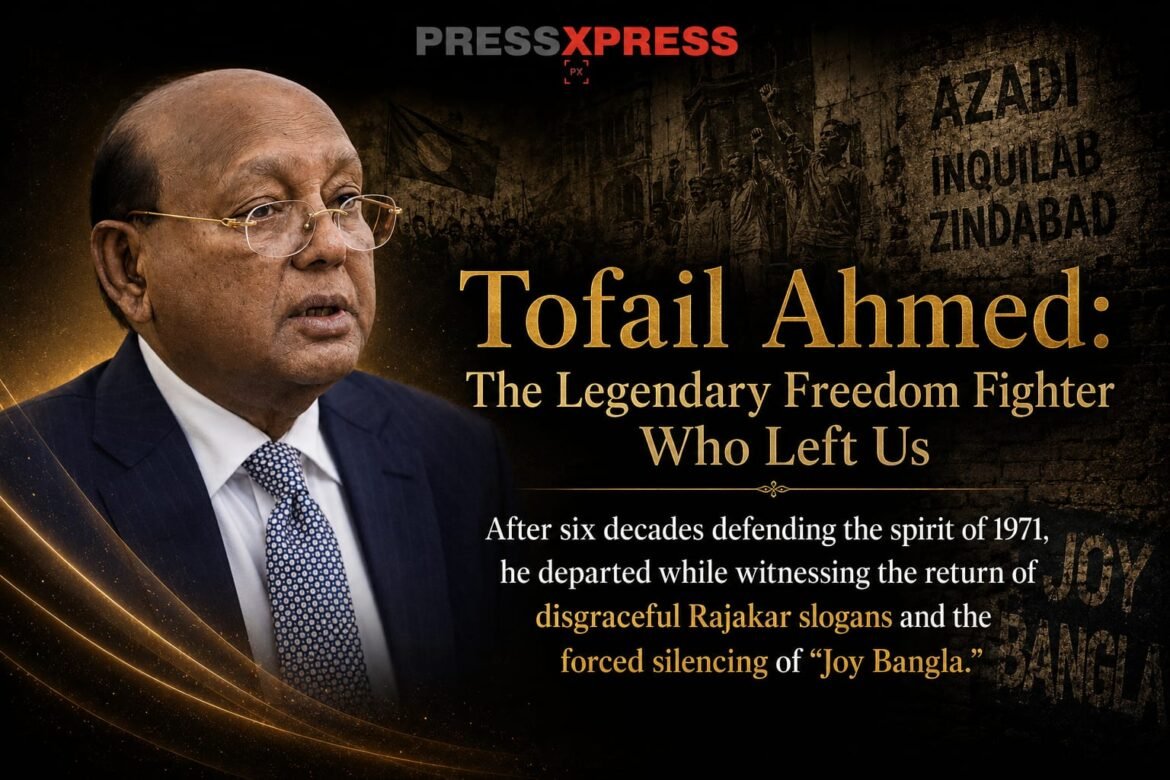
Few political figures in Bangladesh’s history stood at the centre of as many defining national moments as Tofail Ahmed.
His death on 1 June 2026 marks more than the passing of a veteran politician. It represents the gradual departure of a generation that directly witnessed the struggle against Pakistani military rule, the rise of Bangabandhu Sheikh Mujibur Rahman’s mass leadership, the Liberation War of 1971, and the difficult state-building years that followed independence.
For more than six decades, Tofail Ahmed remained an active participant in Bangladesh’s political journey. He emerged from the student movements of the 1960s, helped shape the Mass Uprising of 1969, participated in the Liberation War, served in Bangabandhu’s government, endured the political storms after 1975, and later became one of the country’s most experienced parliamentarians and cabinet ministers.
His national importance rests not merely on the offices he held, but on the historic stages where he was visibly present.
To understand Tofail Ahmed is to understand a substantial part of Bangladesh’s political history itself.
From Campus Politics to National Leadership
Tofail Ahmed’s political journey began at the University of Dhaka during one of the most turbulent periods in East Pakistan’s history.
His first documented political role came in 1964, when he was elected Sports Secretary of the Iqbal Hall Students’ Union. He later became Vice-President of the same hall union during 1966–67.
During the 1960s, student politics was not a side force. It was the principal engine of democratic resistance, Bengali nationalism and anti-military mobilisation.
By 1968–69, Tofail Ahmed had become Vice-President of the Dhaka University Central Students’ Union, widely known as DUCSU. At that time, DUCSU was one of the most influential political platforms in East Pakistan.
Historical accounts consistently place him among the leading organisers of student mobilisation during the anti-Ayub movement and the protests surrounding the Agartala Conspiracy Case.
What began as campus activism soon evolved into national political leadership.
The Moment That Named Bangabandhu
One of Tofail Ahmed’s most symbolic contributions came on 23 February 1969.
After the withdrawal of the Agartala Conspiracy Case and the release of Sheikh Mujibur Rahman, a massive public rally was held at the Racecourse Maidan in Dhaka. Speaking on behalf of the student movement and the Sangram Parishad, Tofail Ahmed publicly conferred upon Sheikh Mujibur Rahman the title “Bangabandhu.”
That title became inseparable from Sheikh Mujibur Rahman’s political identity and later entered the permanent vocabulary of Bangladesh’s national memory.
The 1969 Mass Uprising
The Mass Uprising of 1969 transformed the political future of Pakistan and accelerated the chain of events that eventually led to Bangladesh’s independence.
Tofail Ahmed was one of the principal student organisers of that movement. Working through the All-Party Student Action Committee, he helped coordinate demonstrations, strikes, public resistance and political mobilisation against the Ayub Khan regime.
The movement united students, workers, professionals, political activists and civil society groups under a common demand for democracy and Bengali self-determination.
For Tofail Ahmed, 1969 was the moment when he moved from student politics into the front line of national history.
From the 1970 Election to the Liberation War
The year 1970 brought another defining chapter.
At the age of 27, Tofail Ahmed entered national electoral politics as an Awami League candidate during Pakistan’s historic general election.
The election delivered a sweeping victory for Sheikh Mujibur Rahman and the Awami League. But the refusal of Pakistan’s ruling establishment to transfer power pushed the country into a deeper crisis.
When the Liberation War began in March 1971, Tofail Ahmed moved from electoral politics into the struggle for national independence.
Historical records place him among the senior figures of Mujib Bahini, also known as Bangladesh Liberation Force. Different sources describe his wartime role in different ways — as a central commander, regional commander or senior organiser. But the record consistently places him within the upper tier of Mujib Bahini leadership.
His wartime role included political organisation, youth mobilisation, resistance coordination and support for liberation operations.
This placed him among a small group of leaders whose political legitimacy was forged through both democratic politics and wartime sacrifice.
Inside the Bangabandhu Government
After independence, Bangladesh faced the enormous task of rebuilding a war-ravaged nation.
On 14 January 1972, Bangabandhu Sheikh Mujibur Rahman appointed Tofail Ahmed as his Political Secretary with the rank of State Minister.
The appointment reflected deep political trust and placed him close to the centre of the founding government.
During the early years of Bangladesh, he became part of the political process through which the liberation struggle was being transformed into state institutions, governance structures and parliamentary life.
His election to the First Jatiya Sangsad further confirmed his transition from movement politics into the parliamentary state of independent Bangladesh.
The Post-1975 Political Storm
The assassination of Bangabandhu on 15 August 1975 changed the political course of Bangladesh.
Like many senior Awami League leaders, Tofail Ahmed faced detention, marginalisation and political pressure under successive regimes.
These years became central to his political identity.
For many Awami League activists, he became a symbol of continuity with the Bangabandhu political tradition during a period when that tradition faced severe pressure.
The decades after 1975 transformed him from a young movement leader into one of the most recognisable senior figures of the party.
Parliament, Policy and Economic Stewardship
Although history will likely remember Tofail Ahmed first as a movement politician, his ministerial career also coincided with important economic developments.
He served as Minister for Commerce and Industries from 1996 to 1999 and later continued as Industries Minister until 2001.
During this period, Bangladesh’s merchandise exports increased from approximately US$3.54 billion in 1996 to US$5.49 billion in 2000.
The period also saw the introduction of Industrial Policy 1999, one of the key industrial policy frameworks of that era.
In a later phase, he served as Commerce Minister from 2014 to 2018. Under the framework of Export Policy 2015–2018, Bangladesh’s official export earnings increased from approximately US$34.42 billion in FY2014–15 to US$41.25 billion in FY2017–18.
These figures should be understood carefully. They were collective state and market outcomes involving government institutions, exporters, industries, workers, investors and global trade conditions. But they remain measurable developments that occurred during his stewardship of key economic ministries.
He also served as Chairman of the Parliamentary Standing Committee on Industries and remained active in trade diplomacy through platforms such as the WTO and BIMSTEC.
Bhola: The Political Base
While national politics defined his public profile, Bhola remained the foundation of Tofail Ahmed’s electoral career.
Across multiple decades, he repeatedly secured parliamentary victories from the district and became one of its most influential political figures.
Several development milestones are associated with his long influence in Bhola, including residential gas supply beginning in 2013, the Maya Bridge in 2015, and dredging of the Sripur–Bhola–Gangapur river route in 2017.
These projects alone do not constitute a full development audit of the district, but they represent tangible infrastructure markers linked to his political tenure.
Public sources differ on the exact number of parliamentary terms he served. Depending on the counting method, he has been described as a seven-time, eight-time or nine-time parliamentarian.
The difference appears to come from whether analysts include his 1970 Pakistan National Assembly victory, his 2024 election victory, or only completed Jatiya Sangsad terms.
What is beyond dispute is that he remained one of the longest-serving and most enduring political figures in Bangladesh’s parliamentary history.
The Final Years
In his later years, Tofail Ahmed served as a member of the Awami League Advisory Council and remained one of the party’s senior-most leaders.
More importantly, he became one of the last prominent representatives of the generation that had directly experienced the anti-Ayub movement, the Six-Point era, the 1969 Mass Uprising, the Liberation War and the Bangabandhu government.
As newer generations entered politics, Tofail Ahmed increasingly represented institutional memory.
His speeches carried not only political messaging, but also firsthand experience of the events that shaped modern Bangladesh.
Legacy and the Continuing Battle Over 1971
The easiest way to describe Tofail Ahmed is as a former minister.
The more accurate way is to describe him as a movement politician who later became a minister.
His enduring place in Bangladesh’s history rests on four defining roles: his leadership in the 1968–69 student movement, his public role in conferring the title “Bangabandhu,” his participation in the Liberation War through the Mujib Bahini structure, and his service within the early political circle of Bangladesh’s founding government.
Those moments place him among the small group of political figures who stood at the crossroads of Bangladesh’s most consequential chapters.
His passing comes at a time when the meaning of 1971, the status of liberation-war narratives and the future direction of national identity remain deeply contested.
For pro-liberation forces, this is not merely a political debate. It is a struggle over the moral foundation of the republic — the memory of three million martyrs, the suffering of women during the war, the sacrifice of freedom fighters, and the national spirit expressed through “Joy Bangla.”
Tofail Ahmed belonged to a generation that viewed the Liberation War not as a ceremonial chapter of history, but as the founding source of Bangladesh’s identity.
That is why his departure feels historically painful.
After six decades defending the spirit of 1971, he left at a time when the country was again being tested by the return of disgraceful Rajakar slogans and the forced silencing of “Joy Bangla.”
As the generation that fought for independence gradually leaves the national stage, the question before Bangladesh is no longer only how it will remember leaders such as Tofail Ahmed.
The deeper question is how future generations will protect, interpret and carry forward the spirit of 1971 itself.