Dhaka | PressXpress Analysis
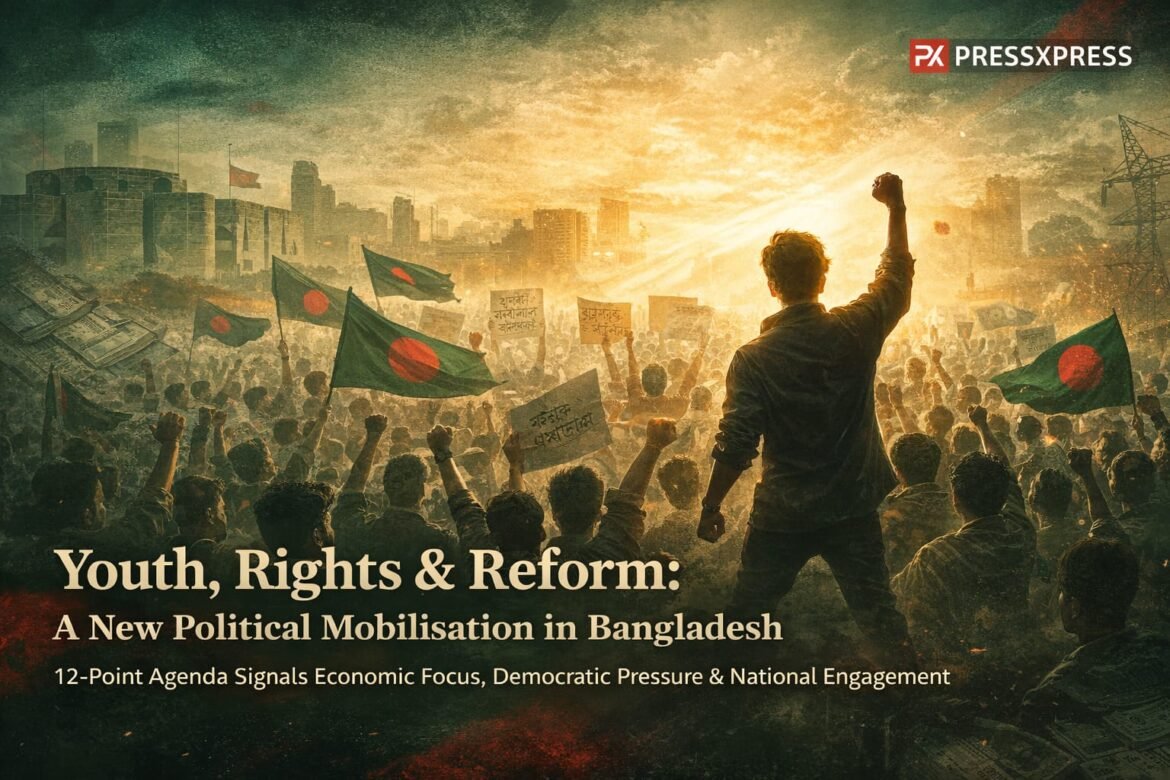
In a renewed attempt to reassert political narrative presence amid mounting socio-economic pressure, the Bangladesh Chhatra League has launched a nationwide campaign combining street mobilisation, ideological messaging, and structured policy demands.
The initiative—anchored in a 12-point public demand framework—comes at a time when Bangladesh is navigating economic strain, political polarization, and institutional tension. This positions the student front as a frontline mobiliser in shaping broader democratic discourse.
According to the official circular issued by the central executive committee, the programme includes nationwide leaflet distribution, wall writing campaigns, and a coordinated online mobilisation strategy. Scheduled from April 18 to April 30, the campaign spans universities, colleges, districts, upazilas, and grassroots units, reflecting a hybrid mobilisation model that integrates traditional street politics with digital outreach.
At the core of the initiative lies a comprehensive 12-point demand set, blending public welfare priorities with political positioning. The framework addresses key national concerns, including education, healthcare, energy, employment, agriculture, and governance. From inflation control to youth employment, and from electricity stability to farmers’ rights, the agenda captures multiple pressure points currently affecting citizens across Bangladesh.
Beyond political signaling, the campaign carries constructive dimensions that may contribute to national stability and policy discourse. By prioritizing issues such as education, healthcare, inflation, and employment, it shifts attention toward citizen-centric governance and reinforces accountability around pressing economic challenges. In a country where demographic strength lies heavily with its youth population, the initiative also promotes structured civic engagement, transforming concern into organized participation while fostering a new generation of leadership grounded in national realities.
Demands related to electricity, fuel, and transport costs further create policy-level pressure for improved service delivery, highlighting the urgency of addressing economic inefficiencies. At the same time, the emphasis on inflation, industrial slowdown, and employment gaps aligns political messaging with macro-economic conditions, contributing to a more grounded and relevant national dialogue. Calls for legal fairness and political participation reinforce the importance of rule of law, due process, and broader public awareness of governance structures.
From a strategic perspective, the campaign operates across multiple layers. It positions itself as a voice for public rights and democratic continuity while directly engaging with real-time economic challenges faced by citizens. The initiative also signals organizational cohesion and leadership alignment around Sheikh Hasina, alongside a broader reactivation of grassroots networks across the country.
The potential implications of the campaign are significant. On one hand, it may increase public awareness of national challenges, strengthen youth participation in governance discourse, and generate constructive pressure on institutions for policy responsiveness. On the other hand, if not managed carefully, it carries risks of street-level tensions, heightened political polarization, and intensified narrative conflicts in the digital space.
Ultimately, the Bangladesh Chhatra League’s latest initiative should be viewed not only as a political mobilisation effort but also as a platform for amplifying public concerns. If executed with discipline and responsibility, it holds the potential to strengthen democratic engagement, accelerate policy responsiveness, and channel youth energy into constructive nation-building pathways.
This is more than a campaign. It is a structured attempt to connect public demand, youth participation, and political narrative into a unified national conversation. Its ultimate impact will depend not only on mobilisation strength, but on how effectively that energy is directed toward inclusive and constructive national outcomes.