The Doomsday Clock is a symbol that represents the likelihood of a human-made global catastrophe, in the opinion of the members of the Bulletin of the Atomic Scientists. The clock is a metaphor, not a prediction, for threats to humanity from unchecked scientific and technological advances. The closer the clock’s hands move to midnight, the closer we are to destroying the world.
The Doomsday Clock was first introduced in 1947 when the Bulletin of the Atomic Scientists published its first magazine cover with a clock set at seven minutes to midnight. The clock was designed by artist Martyl Langsdorf, who chose the time based on her aesthetic preference. Since then, the clock has been moved 25 times, mostly in response to the nuclear arms race, the Cold War, and other geopolitical events.
You can also read: India interim budget 2024-25: Key takeaways
But how seriously should we take this clock? Is it a reliable indicator of the world’s vulnerability to global catastrophe? Or is it a sensationalist gimmick that exploits people’s fears and anxieties? In this article, we will examine the history, methodology, and criticism of the Doomsday Clock, and explain why no one should take it seriously.
How is the Clock Set?
The farthest the clock has been from midnight was 17 minutes in 1991 after the United States and the Soviet Union signed the Strategic Arms Reduction Treaty. The closest the clock has been to midnight was 90 seconds in 2023 and 2024, due to the war in Ukraine, the Israel-Gaza conflict, the climate crisis, and the advances in artificial intelligence.
The clock is set every year by the Bulletin’s Science and Security Board, which consists of a group of experts in nuclear weapons, climate change, and disruptive technologies. The board consults with the Bulletin’s Board of Sponsors, which includes 10 Nobel laureates. The board also considers public opinion polls, media coverage, and letters from the public.
The Clock Has Been Proven Wrong Before
The Doomsday Clock is not meant to be a precise measurement of the world’s risk of catastrophe, but rather a visual metaphor that reflects the board’s subjective assessment of the global situation. However, some of the board’s statements and predictions have been proven wrong by history, or have been criticized for being too alarmist or too optimistic.
For example, in 1953, the clock was moved to two minutes to midnight, after the United States and the Soviet Union tested their first hydrogen bombs. The board warned that “only a few more swings of the pendulum, and, from Moscow to Chicago, atomic explosions will strike midnight for Western civilization.” However, despite the escalating nuclear arms race, the world did not experience a nuclear war.
In 1963, the clock was moved back to 12 minutes to midnight, after the United States and the Soviet Union signed the Partial Test Ban Treaty, which banned nuclear tests in the atmosphere, in space, and underwater.
The board praised the treaty as “a step toward reducing the risk of nuclear war.” However, the treaty did not prevent the proliferation of nuclear weapons, nor did it address the underground tests that continued to pose environmental and health risks.
In 1984, the clock was moved to three minutes to midnight, after the United States and the Soviet Union resumed their nuclear arms race and deployed new weapons in Europe. The board declared that “the world is more dangerous now than at any time since the start of the nuclear age.” However, only a few years later, the Cold War ended peacefully, and the two superpowers agreed to reduce their nuclear arsenals.
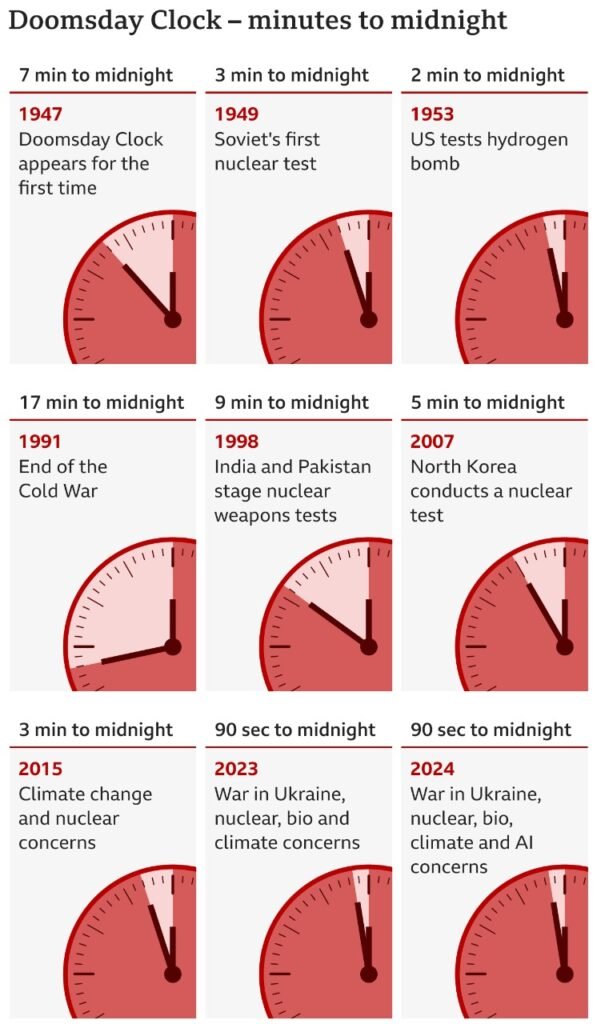
In 2007, the clock was moved to five minutes to midnight, after the board added climate change and disruptive technologies to its list of threats. The board stated that “the dangers posed by climate change are nearly as dire as those posed by nuclear weapons.” However, some climate scientists and environmentalists argued that the board underestimated the urgency and severity of the climate crisis and that the clock should have been closer to midnight.
Why is climate change relevant to the doomsday clock?
Climate change is relevant to the doomsday clock because it is one of the most serious and urgent threats to humanity and the planet. Climate change affects not only the physical environment, but also the social, economic, and political systems that sustain human civilization. Climate change can worsen existing conflicts, create new ones, and undermine human rights, democracy, and development. Climate change can also trigger or exacerbate humanitarian crises, such as food insecurity, water scarcity, displacement, and disease. Climate change can also increase the likelihood of nuclear war, as it can create competition and tension over scarce resources, destabilize regions, and weaken the capacity of states to manage crises. Therefore, addressing climate change is essential for preventing global catastrophe and ensuring a livable future for all.
A tool for Apocalypticism and Fearmongers
The Doomsday Clock has been criticized for being a tool for apocalypticism and fearmongering, rather than a constructive way of raising awareness and inspiring action. Some critics argue that the clock is based on subjective judgments, not a quantitative or transparent methodology. They also point out that the clock does not account for the positive developments and solutions that have emerged to address the global challenges.
Some critics also contend that the clock is counterproductive, as it creates a sense of hopelessness and despair among the public, rather than a sense of agency and responsibility. They claim that the clock fosters a fatalistic attitude that nothing can be done to prevent the inevitable doom or a complacent attitude that someone else will solve the problems. They suggest that the clock should be replaced by a more optimistic and empowering symbol, such as a sunrise or a compass.
Has the doomsday clock become a joke?
The Doomsday Clock has also been mocked and ridiculed for being a joke, rather than a serious indicator of the world’s peril. Some critics argue that the clock is irrelevant and outdated, as it does not reflect the complex and dynamic nature of global threats. They also note that the clock has lost its credibility and impact, as it has been moved too often and too arbitrarily, or has failed to capture the public’s attention and interest.
Some critics also joke that the clock is a self-fulfilling prophecy, as it may actually increase the likelihood of a catastrophe by provoking or provoking the very actors that pose the threats. They also joke that the clock is a marketing gimmick, as it generates publicity and donations for the Bulletin of the Atomic Scientists, or a publicity stunt, as it coincides with the release of movies or books that feature the clock or the apocalypse.
Should we take the clock seriously?
The Doomsday Clock should not be taken seriously, as it is not a reliable or useful measure of the world’s vulnerability to global catastrophe. The clock is based on subjective and arbitrary assessments, not on objective and rigorous analyses. The clock is influenced by political and ideological biases, not by scientific and ethical principles. The clock is a metaphor, not a prediction, and it does not account for the uncertainty and variability of the future.
The Doomsday Clock should also not be taken seriously, as it is not a constructive or effective way of raising awareness and inspiring action. The clock is a tool for apocalypticism and fearmongering, not for education and advocacy. The clock is a symbol of doom and gloom, not of hope and opportunity. The clock is a source of despair and paralysis, not of agency and responsibility.
The Clock was Never Truly Relevant
The Doomsday Clock is more of a metaphorical expression than a true barometer of nuclear apocalypse/ It does not accurately or meaningfully represent the world’s risk of catastrophe. The clock is a flawed and outdated concept, that has been proven wrong by history, criticized by experts, and mocked by the public. The clock is a distraction and a hindrance, that diverts attention and resources from the real and urgent problems and solutions.
Instead of focusing on the Doomsday Clock, we should focus on the actual threats and opportunities that face humanity and the planet. We should rely on the best available evidence and knowledge, not on the opinions and judgments of a few. We should engage in constructive and collaborative dialogue and action, not in sensationalist and divisive rhetoric and propaganda. We should embrace a vision of a better and brighter future, not a fear of a worse and darker one.