As the aviation industry promises a carbon-neutral future, the question remains: can it truly achieve net-zero emissions by 2050, and at what cost to the average passenger?
The aviation industry, long considered one of the hardest to decarbonize, has set an ambitious goal to reach net-zero emissions by 2050. This vision, dubbed Jet Zero, aims to make air travel carbon-neutral, with the UK government committing to eliminating emissions from all domestic flights by 2040. But as the industry pushes towards this target, one question remains: How realistic is it, and at what cost to the consumer?
The Scale of the Challenge
Air travel is responsible for a significant portion of global carbon emissions. For context, a single economy-class flight from London to New York generates 309 kilograms of CO2—equivalent to the annual carbon absorption of 10 mature trees. Multiply this by the estimated 4.5 billion passengers flown globally in 2022, and the scale of the emissions problem becomes glaringly apparent.
To offset the UK’s aviation emissions alone, the industry would need to plant roughly 100 billion trees annually—an area equivalent to the size of Wales. This raises a critical question: How feasible is it for the industry to achieve its net-zero goals by 2050?
Technology and Operational Improvements
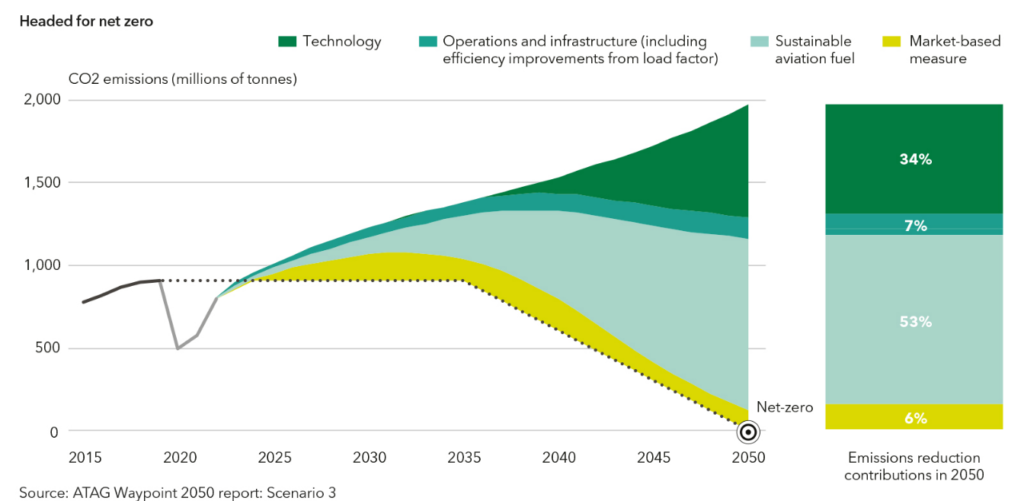
A significant part of the Jet Zero strategy rests on technological innovation. Improvements in aircraft design and operational efficiencies, such as new jet engines and lighter materials, are expected to contribute to emission reductions. The Rolls-Royce UltraFan engine, for example, promises a 10% reduction in fuel consumption. While promising, the UltraFan won’t be available for commercial use until the 2030s, limiting its immediate impact.
The real breakthrough in reducing emissions may come from sustainable aviation fuels (SAF), which are produced from renewable sources like used cooking oils and agricultural waste. However, SAF comes with its own set of challenges. Currently, SAF production accounts for only 0.1% of global aviation fuel, and scaling up its production to meet global demand would require vast quantities of renewable energy.
The UK government has mandated that 22% of aviation fuel must come from sustainable sources by 2040. But scaling up SAF production is no simple task. Critics argue that relying on SAF made from waste oils and fats, some of which are shipped from Asia, may only shift the problem without truly addressing the emissions issue.
Airspace Modernization and Fuel Efficiency
Another key component of Jet Zero is improving fuel efficiency through airspace modernization. At present, aircraft often fly routes determined by a network of beacons, which can result in inefficient flight paths. Modernizing air traffic control with satellite technology could allow planes to fly more direct routes, reducing fuel consumption and emissions.
The UK’s National Air Traffic Services (NATS) estimates that airspace modernization could cut emissions by up to 15% by 2050. However, these changes will take years to implement, and they rely on significant infrastructure investments that may be delayed.
The Race for Electric and Hydrogen Planes
The promise of fully electric or hydrogen-powered aircraft is another part of the aviation industry’s decarbonization strategy. In a breakthrough effort, British inventor Stephen Fitzpatrick has developed the VX4, an electric aircraft powered by lithium-ion batteries. Though promising, the VX4’s range is limited to just 100 miles—far from the range needed for long-haul flights. The future of electric planes may lie in hybrid models that combine battery and hydrogen fuel cells to extend range.
Hydrogen-powered aircraft, like those being developed by ZeroAvia, aim to carry 80 passengers and are expected to be airborne within the next two to three years. However, these planes are still in the prototype stage, and it remains to be seen whether they will be viable for commercial aviation.
Pricing and the Cost to Passengers
Achieving net-zero aviation will come at a cost, and this cost will likely be passed on to consumers. Currently, carbon offsetting schemes are in place to charge airlines for CO2 emissions, but the fees have been controversial, with critics arguing that some offset projects may be ineffective. As part of the Jet Zero strategy, airlines will likely face additional costs for SAF, fuel efficiency improvements, and carbon offsetting, which will inevitably lead to higher ticket prices.
In the UK, domestic flight passengers already pay an environmental tax, with a £7 charge on short-haul flights and up to £92 for long-haul. However, experts like Sir Dieter Helm, Professor of Economic Policy at the University of Oxford, warn that these incremental costs are only the beginning. “Governments don’t want to tell people the full cost,” Helm says. “But there will be higher costs for consumers.”
Duncan McCourt, CEO of Sustainable Aviation, remains optimistic, stating that the cost of carbon reduction measures may add only “a few pounds” to ticket prices, allowing passengers to continue flying while reducing emissions. However, given the scale of the challenge, the total cost of decarbonizing the aviation sector could rise sharply in the coming years.
What’s Next?
The UK’s Jet Zero initiative aims to cut aviation emissions by a third through a combination of SAF, fuel efficiency improvements, and new technologies. However, with air traffic set to increase by 150 million flights per year by 2030, the goal of achieving net-zero aviation by 2050 looks increasingly daunting.
Aviation is essential for global connectivity, but it is also one of the most carbon-intensive industries. While the road to Jet Zero is fraught with challenges, technological innovations, policy measures, and changes to consumer behavior will all play a critical role in determining whether the aviation industry can meet its carbon-neutral ambitions by 2050.
Passengers, meanwhile, will likely face higher ticket prices as the true cost of aviation’s environmental impact is accounted for in future flight costs. Ultimately, Jet Zero may not be an idealistic dream but a practical challenge for governments, airlines, and passengers alike.