
Phnom Penh | PressXpress Analysis
Cambodia’s ongoing crackdown on cybercrime and online scam operations has resulted in the detention and deportation of thousands of foreign nationals, particularly from Bangladesh, India, and Pakistan. While these actions demonstrate strong enforcement, a deeper structural issue continues to undermine long-term impact.
The critical question remains: Are the real operators behind this system being targeted?
The Reality Behind the Arrests
Field observations and regional intelligence indicate that many of those detained are not the masterminds, but trafficked or misled individuals.
Recruited through promises of legitimate jobs, they arrive in Cambodia only to find themselves trapped inside controlled scam environments:
- Passports confiscated
- Movement restricted
- Forced participation in fraudulent activities
This suggests that current enforcement is largely addressing the visible layer—not the command structure.
The Syndicate Structure: Small Core, Large Impact
Available intelligence points to a highly concentrated network of approximately 8–12 key coordinators, supported by 40–50 facilitators and associates.
What makes this network difficult to detect is its dual identity:
- Publicly, they operate as legitimate business owners
- Construction companies
- Restaurants
- Travel agencies
- Small trading firms
- Privately, they function as coordinators of recruitment, logistics, and compound-level supply chains
Many of these actors are long-term residents in Cambodia and are believed to maintain cross-border connections within South Asian communities, enabling continuous recruitment and movement.
This structure allows them to operate under the radar, blending into the local economy while sustaining a transnational trafficking pipeline.
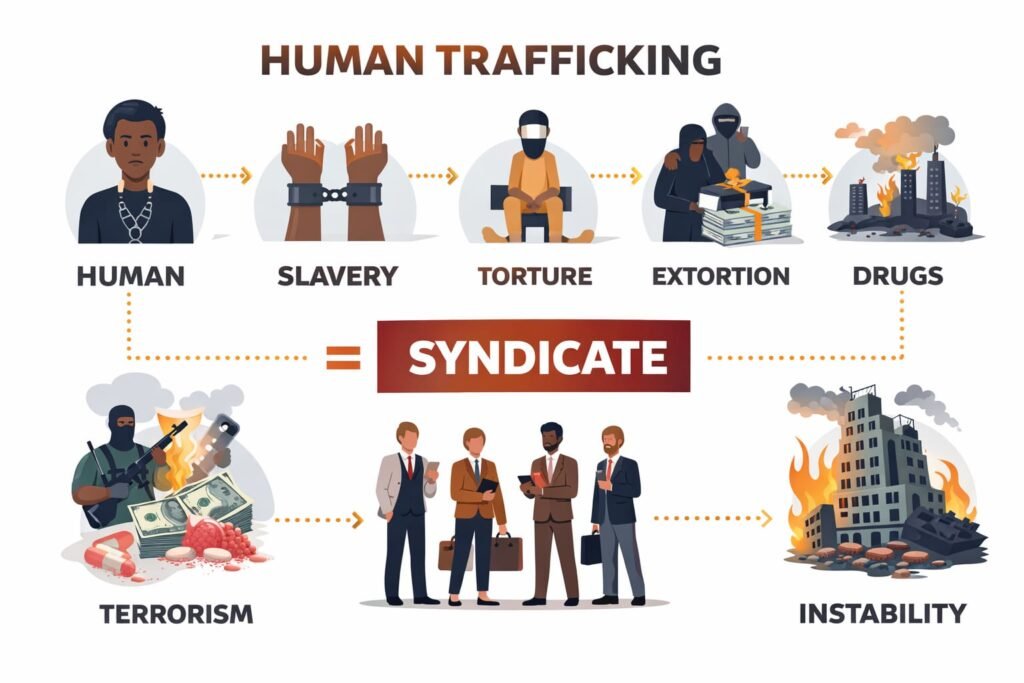
The Recruitment Pipeline: Digital and Invisible
The system begins outside Cambodia.
A network of brokers and sub-agents operates primarily through:
- Facebook job groups
- Telegram and WhatsApp channels
- Informal agents collecting “processing fees”
- Irregular visa facilitation and airport-level handling
Victims are handed over upon arrival and transferred into controlled environments.
As long as this pipeline remains active, every deportation is replaced by a new arrival.
From Cybercrime to Security Threat
The issue is no longer limited to online scams.
The same networks are increasingly associated with broader risks:
1. Human Trafficking & Illegal Entry
Organized, continuous inflow through irregular systems.
2. Kidnapping, Extortion & Coercion
Victims subjected to threats, abuse, and ransom demands.
3. Narcotics Circulation
The spread of Yaba-type stimulants within these networks raises serious concern.
4. Escalating Security Risk
When trafficking networks intersect with narcotics and unregulated migration flows, the risk of extremist exploitation increases.
Even isolated cases of radical or criminal elements entering through these channels can escalate into broader security threats if left unchecked.
5. Organized Cybercrime Infrastructure
Scam platforms are sustained by structured syndicates, not individual operators.
The Strategic Gap
Despite visible crackdowns, the core syndicate layer remains largely intact.
This creates a repeating cycle:
- Workers are arrested
- Victims are deported
- Networks remain operational
- New victims are recruited
Without targeting the central coordinators and their financial networks, enforcement efforts will continue to produce only temporary results.
Why This Matters No
Cambodia is positioning itself as a stable, investment-driven, and tourism-friendly nation under Prime Minister Hun Manet.
However, the continued existence of trafficking-linked syndicates:
- Damages international perception
- Discourages serious investors
- Creates long-term security vulnerabilities
Removing this network would not only reduce crime—but also restore confidence in Cambodia’s economic and governance environment.
A Strategic Imperative
A more focused approach is required:
- Target the core coordinators, not just operational workers
- Disrupt recruitment pipelines at the source
- Monitor front businesses used as operational cover
- Strengthen cross-border intelligence cooperation
- Track financial flows linked to syndicate activity
Conclusion
Cambodia has shown that it can act. Now it must act at the right level.
Arrests alone will not end this crisis.
Confronting the syndicates behind it will.