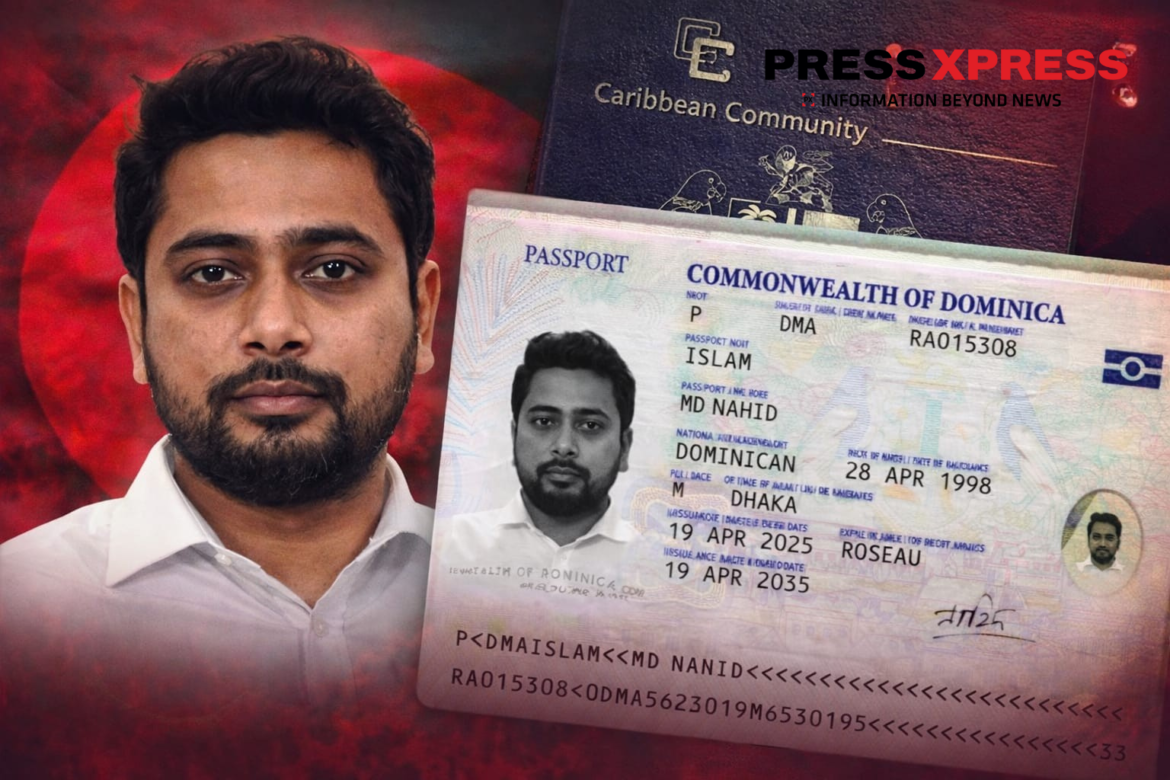
By PressXpress | Special Report
Dhaka | Accountability & Governance Analysis
STANDFIRST
Once hailed as a moral face of the July uprising, Nahid Islam’s post-August record now faces hard questions. From governance failures to the emergence of a foreign passport controversy, this report examines how credibility, acceptability, and public trust have eroded—based on facts, law, and post-revolution outcomes.
FROM REVOLUTION TO RESPONSIBILITY
The political upheaval that culminated on 5 August 2024 was framed by its leaders as a moral rupture with the past. The movement promised an end to corruption, discrimination, authoritarian politics, and elite privilege. Among its most prominent figures was Nahid Islam, who rose from the protest movement to national political relevance by positioning himself as a symbol of ethical renewal and generational change.
Less than a year later, those promises are being tested—by reality.
THE COMMITMENTS AFTER AUGUST 2024
Following the fall of the previous regime, Nahid Islam publicly aligned himself with four core principles:
– No discrimination, no social division
– Zero tolerance for corruption
– Ethical, transparent governance
– Rejection of dynastic and authoritarian political culture
These principles were repeatedly used to justify political mobilization and institutional pressure.
POST-AUGUST REALITY: WHAT THE NATION EXPERIENCED
From August 2024 to mid-2025, Bangladesh experienced deep institutional stress:
– Sharp rise in mob violence and vigilante actions
– Increase in rape, murder, and politically linked killings
– Erosion of law-enforcement authority
– Economic deterioration marked by capital flight, inflation, and job contraction
These developments are reflected in police records, court filings, and verified media reporting.
THE LEADERSHIP GAP
Rather than de-escalation, the post-August period saw escalatory rhetoric, normalization of crowd pressure, and failure to decisively contain mob behavior. This contradicted the promise of “no mobs, no fear, no division.”
THE PASSPORT CONTROVERSY: A CREDIBILITY SHOCK
In 2025, documents and images circulated suggesting Nahid Islam holds a passport of the Commonwealth of Dominica, reportedly issued in April 2025. Dominica operates a Citizenship-by-Investment program typically requiring USD 200,000–250,000.
At the same time, election affidavits submitted to the Bangladesh Election Commission show Nahid Islam declaring annual income of approximately BDT 7–16 lakh.
THE DECLARATION GAP
This raises legitimate public-interest questions:
– How was a six-figure foreign citizenship financed?
– When was the citizenship acquired relative to nomination?
– Was foreign nationality fully disclosed?
– Were funds compliant with Bangladeshi law?
WHAT THE LAW SAYS
Article 66(2)(c) of the Constitution of Bangladesh disqualifies holders of foreign citizenship from being Members of Parliament. Election law requires truthful disclosure; false declaration may lead to disqualification or criminal liability.
BEYOND LAW: COLLAPSE OF MORAL AUTHORITY
A leader who mobilized against elite privilege now faces allegations of acquiring elite foreign citizenship during national economic hardship. This contradiction has eroded trust and acceptability.
WHY THIS CASE MATTERS
This issue is not personal. It concerns equality before law, post-revolution accountability, and democratic credibility.
WHAT ACCOUNTABILITY REQUIRES
1. Public documentary clarification
2. Election Commission verification
3. Transparent disclosure
4. Legal action if violations are found
CONCLUSION
Revolutions are judged by outcomes, not slogans. Moral leadership is tested under scrutiny. If the law is equal for all, clarity is mandatory.
PressXpress will continue to pursue facts, not narratives.