
PressXpress | Strategic Energy & Economic Intelligence
The Reality: This Is an Oil Crisis, Not a War Crisis
Cambodia is not directly affected by the Iran–US/Israel conflict.
But economically, the impact is already arriving through a single channel:
Oil
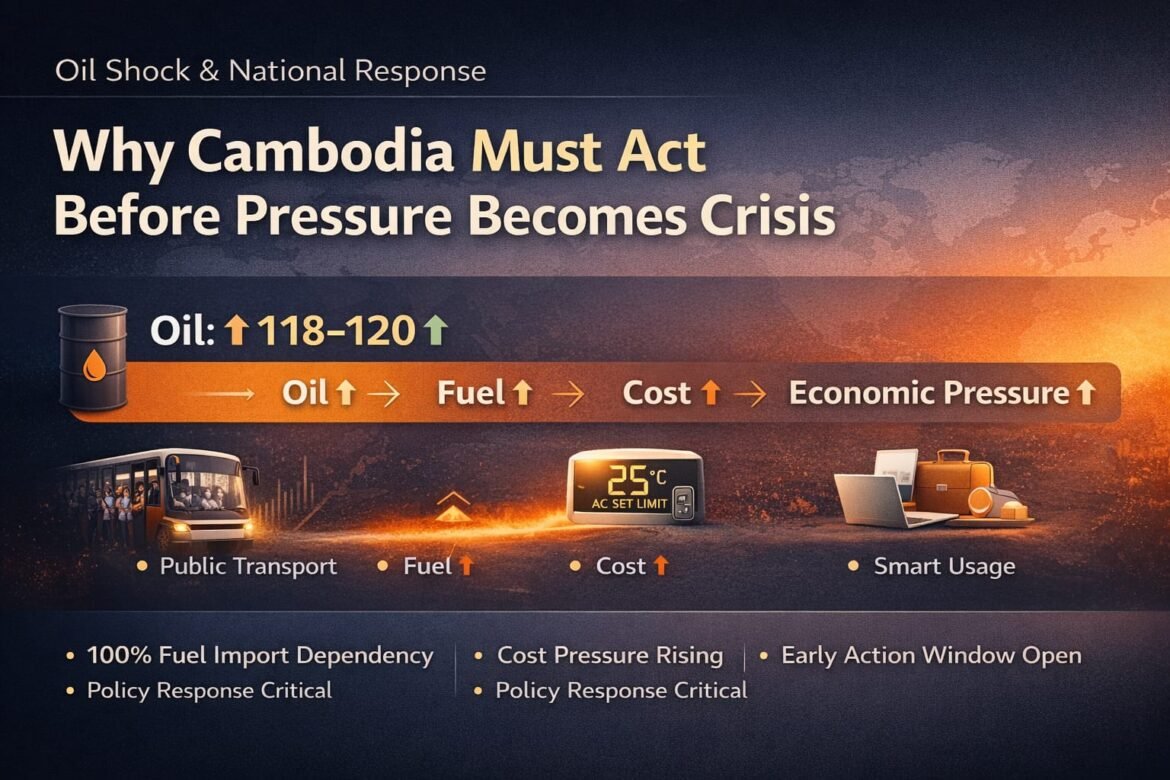
Global oil prices have moved sharply to approximately $118–120 per barrel, up from around $109 just days earlier. At the same time, global supply disruption risk is estimated at 12–15 million barrels per day, particularly around key transit routes such as the Strait of Hormuz.
For a country like Cambodia — which relies entirely on imported fuel — this creates a clear and unavoidable transmission:
Oil ↑ → Fuel ↑ → Transport Cost ↑ → Food & Goods Price ↑ → Cost of Living ↑
This is not a theoretical model. It is already visible across global markets, and historically, such shocks tend to pass through quickly into domestic economies.
Why Oil Matters More Than Any Other Variable
Oil is not just another commodity. It is the base input of the entire economy.
- Transport depends on fuel
- Logistics depends on fuel
- Agriculture depends on fuel
- Construction depends on fuel
When oil rises, every layer of the economy absorbs cost pressure simultaneously.
This creates three immediate effects:
- Households feel pressure → higher daily expenses
- Businesses lose margin → higher operating costs
- Economic activity slows → reduced consumption
This is why global institutions often describe oil as the “master variable” in times of geopolitical stress.
What Other Governments Are Already Doing
Across Asia and beyond, governments are not waiting. They are acting early to manage both energy supply and consumption behavior.
1. Fuel Supply Protection and Subsidy Measures
Countries such as Japan, Indonesia, and Malaysia are:
- Deploying large-scale fuel subsidy programs
- Allocating emergency funds for energy stabilization
- Securing additional fuel supply contracts
For example:
- Japan has used hundreds of billions of yen from reserves to stabilize gasoline prices
- Indonesia allocated over IDR 300 trillion for fuel and electricity support
- Malaysia increased monthly subsidy allocation to maintain price stability
👉 Purpose:
To prevent sudden fuel price shocks from cascading into inflation.
2. Energy Consumption Control (Immediate Impact Policies)
Several countries have introduced mandatory and voluntary energy-saving measures, including:
- Air conditioning limits in public buildings (minimum 24–26°C)
- Reduction of non-essential electricity use
- Temporary suspension of decorative lighting
In parts of Asia and Europe:
- Government buildings operate under strict energy-use guidelines
- Public campaigns encourage citizens to reduce daily consumption
👉 Impact:
Even small reductions at scale can significantly reduce national fuel demand.
3. Public Transport and Mobility Optimization
Urban policy shifts are also visible:
- Increased use of public transport systems
- Encouragement of shared mobility
- Temporary incentives for reducing private vehicle use
This is critical because:
A single bus replacing 30–40 private vehicles can reduce collective fuel consumption dramatically.
At a national level, this translates into millions of liters saved daily.
4. Operational Adjustments (Work and Education)
In previous energy stress periods and during COVID-era responses, governments have applied:
- Partial remote work (30–50%)
- Hybrid schooling / temporary home learning
- Reduced working hours for non-essential sectors
These are not extreme measures — they are efficiency measures.
👉 Effect:
Reduced commuting → reduced fuel demand → reduced national energy pressure.
5. Control of High-Consumption Sectors
High-energy consumption sectors such as:
- Casinos
- KTV / nightlife venues
- Large commercial lighting
are often subject to:
- Time restrictions
- Energy usage controls
👉 Reason:
These sectors consume significant electricity but are not essential to economic stability.
Why Cambodia Must Act Early
Cambodia’s exposure is higher than many countries because:
- It is 100% dependent on imported fuel
- It has limited buffer capacity
- Urban transport is heavily private-vehicle dependent
This means:
Cambodia does not have the luxury of waiting for the shock to fully materialize.
If action is delayed, the country will face:
- Faster cost-of-living increases
- Stronger pressure on small businesses
- Higher inflation transmission
- Greater public anxiety
What Cambodia Should Do — Now
The response does not need to be extreme.
But it must be early, coordinated, and visible.
🔴 1. National Energy Discipline Measures
- Set AC temperature guidelines (≥25°C)
- Reduce non-essential electricity usage in public buildings
- Limit decorative and ceremonial lighting
👉 These measures alone can reduce national energy consumption significantly.
🔴 2. Public Transport Promotion
- Encourage use of buses and shared transport
- Promote carpooling in urban areas
👉 Even a 10–15% shift from private vehicles can produce meaningful fuel savings at the national level.
🔴 3. Smart Operational Adjustment
- Introduce partial remote work (especially government & services)
- Consider temporary home-based learning where applicable
👉 Reduced commuting directly reduces fuel consumption.
🔴 4. Energy Supply Strategy
- Secure additional fuel supply contracts
- Prepare contingency fuel reserves
- Evaluate targeted subsidy mechanisms
👉 Ensures continuity even if global disruption worsens.
🔴 5. Control High-Energy Consumption Sectors
- Apply time or usage limits to non-essential high-energy businesses
- Monitor electricity consumption patterns
👉 Prevents unnecessary energy drain during a critical period.
🔴 6. Public Communication & Narrative Control
- Clearly explain the situation to the public
- Promote energy-saving behavior
- Prevent misinformation and panic
👉 In times of economic pressure, narrative stability is as important as policy stability
What Happens If No Action Is Taken
If current trends continue without intervention:
Within 2–4 weeks, Cambodia may face:
- Noticeable increase in fuel and transport costs
- Rising food prices
- Business margin compression
- Slower economic activity
And most importantly:
A shift from controlled pressure → uncontrolled reaction
Final Strategic Insight
Cambodia is not yet in crisis.
But it is entering a pressure-sensitive phase driven by oil and energy dependency.
The difference between stability and instability will depend on timing of action.
Final Word
The global situation is changing quickly.
Oil has already moved. The effects will follow.
“In an oil-driven shock, the cost of waiting is always higher than the cost of early action.”

